One of the big regrets of my life is that I haven’t (so far) competed in a motor race. While being heavily involved with the motor sport scene throughout my career, I’ve never been given the opportunity, or committed myself to creating the opportunity, to ‘have a go’.
I’d really like to do it, just once, just to prove I wouldn’t have been that good, and to be secure in that knowledge. Though there was that time with the Porsche track day instructor at Oulton Park who two corners in to my lap said to me; “I can see you’ve done this before, have you raced?” I suggested we went back and got me a bigger crash helmet, even though I was already wearing the largest of the four sizes (small, medium, large, journalist…).
Occasionally, however, I am given a close-up demonstration as to why I wouldn’t have been that brilliant a racer – a snapshot showing how the really good race drivers are very much on a different planet to the rest of us. This week is a case in point.
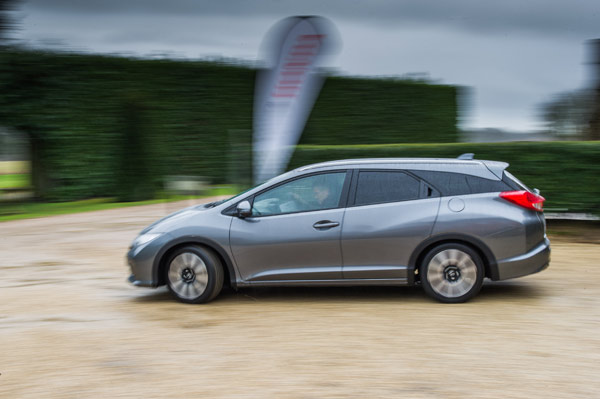
 The occasion is the launch of Honda’s new Civic Tourer, another new contender in a new and growing niche, the downsized estate car. Increasingly it seems, we prefer our load luggers to be crafted from mid-sized family hatches, rather than the larger environment of the Mondeos, Insignias and Accords.
The Civic is the second debuting mid-sized tourer I’ve driven in a week. And yes, the Civic is very good, reliable and practical, and with apparently more rear space than any of its rivals. On the launch event, however, I don’t admit to preferring the Seat Leon ST I drove last week – it had just a bit more upmarket style for me.
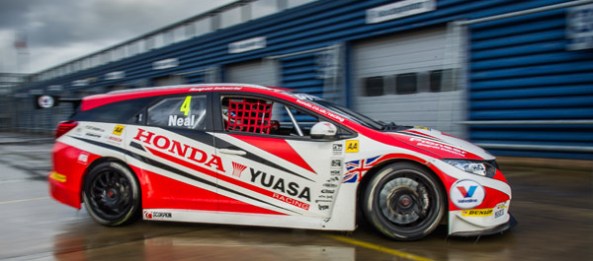
 The Civic Tourer, however, has one major plus, in that it has been chosen to be the new car for Honda’s uber-successful British Touring Car Championship team. As a result, the launch route takes us for lunch to a very wet Rockingham race circuit near Corby, where the BTCC team are conducting the very first runs of the new car.
This is highly familiar territory for me. Getting on for 10 years ago (which is frightening to think about) I spent a season working at Rockingham, back in the days it had an oval racing championship worth watching. My BTCC history goes back much further, to the eight years working in the series in the 90s (even more frightening to think about), at the height of the Super Touring era – great times, when Matt Neal, today the Honda team’s lead driver and a three-time Champion, was just beginning to make his name.
The team’s PR man Richard Tait-Harris, someone who gives the impression of being on a continual neat caffeine drip, reminds me I’ve known him 18 years before trying to embarrass me by gleefully telling all my fellow hacks how he must get all the team info right or I’ll correct him; “Andrew knows more about touring cars than anyone” – I will have my revenge Mr Tait-Harris…
What Richard knows I know, and most of the other journos here don’t, is that despite the new Civic BTCC car having only turned a wheel for the first time in the last couple of days, we are all going to get taken round the track in it by Mr Neal or his team-mate Gordon Shedden – also a champion of the BTCC series.
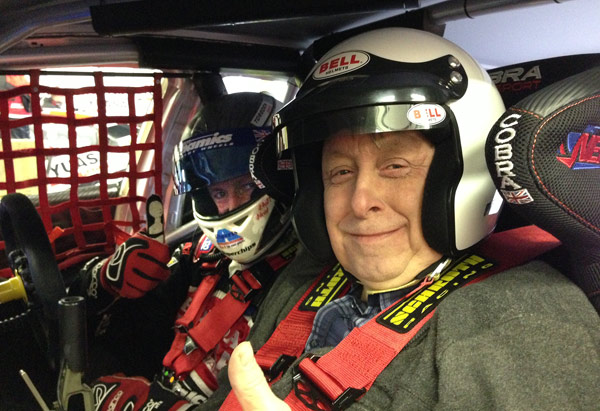 Naturally I am at the front of the queue. Unlike most of my colleagues I have ridden in many a touring car before, but not for several years – I think the last time was in 1997, in an Audi driven by the much-maligned John Bintcliffe, who definitely spent most of the lap trying to scare me as payback for all the laughs we had enjoyed at his expense in Touring Car Worldwide magazine…
Matt welcomes me to the cockpit, and as the belts are tightened around my these days rather portly frame I know that with a familiar and experienced passenger aboard, he won’t be pussy-footing around.
And he certainly does not. Three laps later I have had my lesson, my confirmation that I would never be able to race really well, and the catalyst emphasising this fact is rain. I have never before been around a track so thoroughly wet as the Rock is today, and this is both a highly technical circuit and one that becomes lethally slippery so very easily.
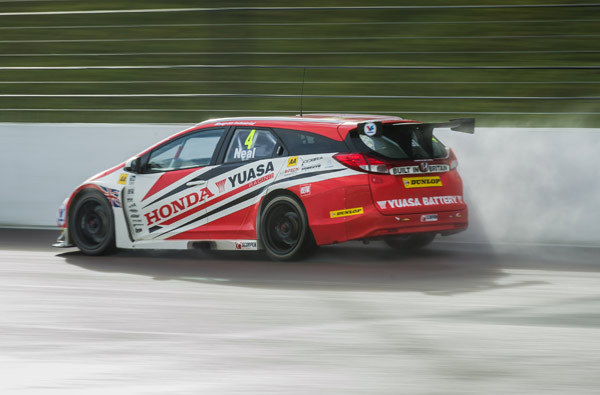 Yet Matt circulates this track at speeds I would probably consider impressive on bone-dry Tarmac. He uses all the road, powering right up to the forbidding concrete wall at the final corner, and he uses more than the road, running across kerbs that are twice as greasy as the track and on this day covered in water and mud.
And the car tries oh-so hard to catch him out, even snapping sideways in a straight line at one point. In the corners it breaks away constantly, viciously, yet Matt’s reaction is instant, myself totally amazed at the way he snaps the steering wheel round in total faith that the tyres that have just lost grip will instantly find it again – which they always do. I can’t imagine having such a speed of reaction, such a complete feel for what the car is doing.
Back in the pits, I learn more about this car, the first estate in the BTCC for two decades. I remember the first one, Volvo’s 850, intimately. It was big and boxy, and a pure publicity stunt to announce the Swedish brand’s arrival in the series – the real, win-contending race car came in the following year, and it was a saloon…
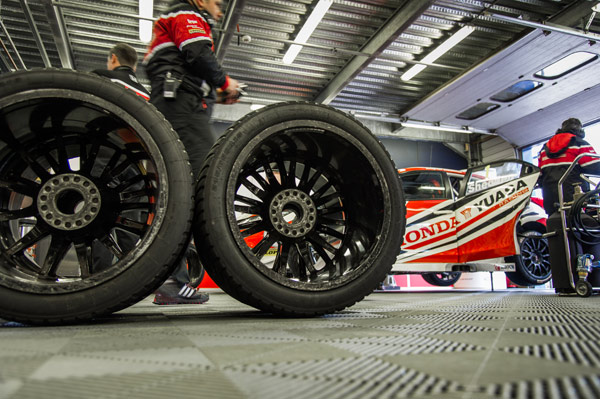 Honda can’t afford to simply perform a publicity stunt – its Civic hatches have won the last three BTCC titles, so the novelty of a Tourer will mean nothing if it’s running down the field amongst the have-nots. Honda expects to carry on winning with this car.
And Honda can be confident. It will surprise many to learn that the idea of racing the Tourer came not from the brand’s very clever marketing types (remember the Cog television ad?), but from Matt Neal, the man who will drive the car. And talking to me, Matt confirms that the Tourer has no technical advantages as a race car – its biggest advantage is that there is no disadvantage…
The car is 240mm longer than its hatch sibling, but that extra length is all in the rear – the wheelbase is the same, so save for some careful redistribution to cope with the extra weight of the shell, mechanically this is the same car as its title-winning predecessor.
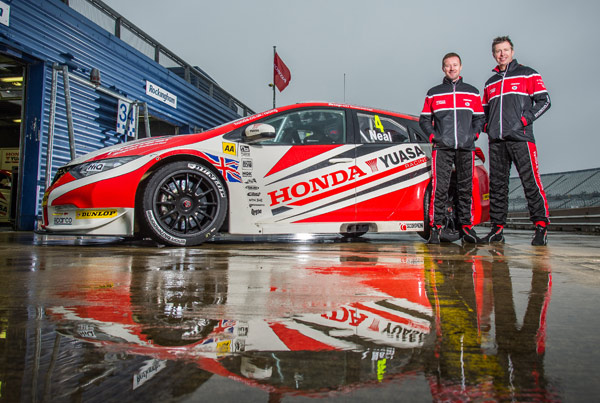 Perhaps the most pertinent indication, however, of just how confident the team is in this car is the test I’m at. People in motor sport will tell you that the first run of a new car is something done on the quiet, ironing out the inevitable issues out of the public gaze. But three days giving passenger rides to journalists? No way…
So Honda’s Tourer will win races, maybe a championship, in 2014. And I’ll look forward to seeing some of those wins, knowing that’s something I just couldn’t do….

 TheShortAxleblog